Thank you
There is real power in those two words. When you say thank you, you can make someone feel seen and heard. You acknowledge someone’s hard work — probably work done on your behalf, and you show your appreciation for that labor. Thank you can also soften a blow of not being interested, like when you turn down an offer by saying “no, thank you.” Thank you is polite, it’s often said without too much thought, as a courtesy. But more often than not, thank you has the power to transform both those who pause and offer thanks as well as those who receive thanks. Even when it’s your job or whatever you did was expected, a thank you just makes you feel good.
I serve as the state president of a volunteer board. This group of women juggle it all — family, careers, community. And our board isn’t an afterthought or an easy commitment. As we finished out 2021, we were stretched thin. Progress felt slow, meetings were both too long and too short, and there was a near constant list of “everything else” begging for our focus and attention.
At our final planning meeting before Christmas, I looked at my computer screen, filled with the wonderful faces of these women who have become friends. I saw the work they were doing for our board and for every other commitment in their lives and I was overwhelmed with gratitude for them. While I couldn’t possibly know the specifics of each board member’s calendar, I knew at that moment, we were present together, working together even when it was difficult and we had as many visions as we have members, and so I told them thank you. Thank you for the work they do, for the commitment they keep, for their generosity with their time, intelligence, and words. And I believe they heard me because they said it back and acknowledged what I was contributing as well. And at that moment, our shoulders relaxed a little bit and the work was easier.
I will shamelessly tell you, I love a thank you. I know some of you might not. But for me, it’s gold. Whether it’s from a client or my kids or a friend, when someone says thank you, I feel lighter. If I was slogging it before, I feel energized to keep going. Knowing someone has seen my efforts and felt compelled to let me know it’s appreciated is sometimes all I need to refocus and get back to work. And not being thanked has a similar effect. When no one says a word of thanks, whether it be for something like a project delivered early or a family dinner, I wonder if it was worth the extra effort — or any effort at all, really.
For me, there’s never a wrong time to say thank you, but there can be a wrong agenda. Telling someone you appreciate them, or their efforts, or their work should be a genuine expression of gratitude. It doesn’t have to be spontaneous, but you should absolutely mean it. And mean it with no hope for future endeavors. When a family member helps me with something around the house, I let them know I appreciate it, but I’m not using a thank you as a bribe or manipulation to get them to do it again. (Anyone remember being told if you liked getting Christmas presents you better send a good thank you note the very next day?)
The same goes with clients. I thank my clients for every work project because I am genuinely grateful for each opportunity. And in December, I took time to send many of my clients a quick note of appreciation, although I try to make sure my clients feel appreciated all year long. I hope they understand my thankfulness and know that I am truly grateful for their partnerships — without hope or agenda. While December is an excellent time to send a thank you to your clients, or those with whom you are professionally associated, via holiday mail, there’s nothing magical about the end of the year. A heart-felt thank you can be sent anytime.
And to that end, even though it’s January and the big holiday season is behind us, thank you, dear reader, for your time today, for reading my little blog. I hope you feel inspired to offer thanks and gratitude to others with reckless abandon, today and everyday.
Cheers.
Just Send It
Maybe it’s everyone, maybe it’s just editor/writer types, or maybe it’s just me, but I find that I have been spending a lot of time editing an email lately. Sending an email sounds easy enough. I need to send back this project or query an author or touch base with a client or get information out to my volunteer board. But that’s where I get stuck. I edit sentence structure, I delete content (will that read as funny or just confusing?) I change the format from bullets to numbers. Before long, a quick email has turned into a 30 minute project of its own.
I’m not procrastinating in a traditional sense, although I’ve heard it said that perfectionism is a form of procrastination. I think my email situation is something else, more likely that when I send an email, it’s the one opportunity I have to be fully myself. I’m not reviewing someone else’s work, I’m not writing in someone else’s voice, and when all the masks are striped away, I feel a little vulnerable and exposed. So I overthink it. All of it.
I am so lucky to say that my calendar has been full since August. My time must be well-managed to maintain my deadline schedule. So spending 30 minutes on a five minute email has the potential to set me back. This past month, I’ve been working on taking the action to simply send the email.
Maybe you can relate. It could be emails for you or it could be something different, but you find yourself unable/unwilling to move forward for whatever reason. If you find you too are getting stuck at something, here are three things I do to get myself going:
3 … 2 …1: I heard this tip from a Mel Robbins podcast from maybe two or three years ago. You start a countdown, out loud will help, and then blast off when you get to zero and take the action.
Send an email like a text: If I were texting someone, even for work, I keep it short, to the point, and hit that send button. Sometimes I remind myself that an email can be like a text, only with a bigger keyboard. I check for spelling and read it over once and get it out the door. It might feel like emails should have more thought given to them, that they can live forever. But I have a friend whose Marco Polo chats were subpoenaed, and who puts thought into those? So there’s really nothing sacred about an email. And certainly nothing helpful about one that languishes unsent.
Set a timer: my youngest is trying this out in college too. Her literature professor suggested she set a timer for one hour, write for an hour, run spell check and then submit. This keeps her from overthinking, adding in extra information around her argument, or spiraling (as one does) into a total rewrite. Sounds familiar.
My dear friend Jessica Stong is the absolute master of the single take. She made it a guideline for herself and business to not get bogged down in the perfectionism our glossy, photoshopped, post-edited world can demand. Instead, she does her podcasts and client videos in a single take — which makes her about the most authentic personality online.
Sometimes, when I’m re-editing an already edited email, I ask myself … “What would Jessica do?” She’d send the darn email.
For further inspiration, listen to this: https://www.youtube.com/watch?v=w_DKWlrA24k The original audio was completed in a single take in the middle of the night.
Here’s to sending the email, to getting unstuck, and continuing to finish 2021 in a positive and strong way.
Cheers.
Working on the Road
“Excuse me, ma’am. I overheard your conversation just now. (Talking about the new season of Tiger King.) Are you a producer?”
“No, sir. I edited an article about some upcoming TV programs. I don’t work in film. I’m a freelance editor/copy writer. I work wherever the computer is.”
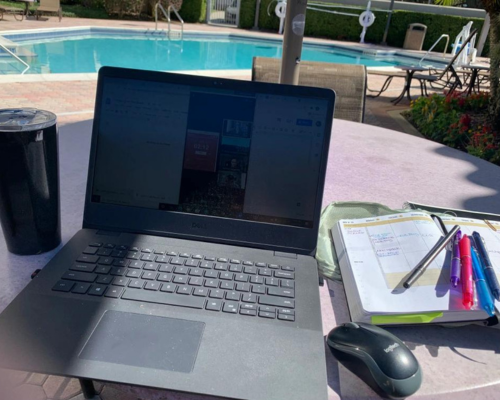
Even as I said it, I was thinking about the accuracy of that statement. Over the last two years, I’ve pulled out my computer and worked on editing and writing projects in six different states, in hotel rooms and coffee shops and an occasional gas station parking lot. I’ve worked at three different beaches and sat next to Plymouth Rock while ghostwriting an article about the electric grid. Today, when I was overheard talking about a project, I was working poolside in 65-degree weather.
This arrangement has a lot of positives. I can go anywhere as long as I can take my laptop. I can see new things, hang out in new climates, get plenty of vitamin D, explore new work environments, and even be overheard by complete strangers who might need a copyeditor. I am not bound by a 9-to-5 schedule or an office in a particular location.
I have always known that I thrived in an unstructured environment but it took a long time, and several careers, to finally have the confidence to do this freelance thing for actual money, to invest in it and believe in it enough to make it a sustainable form of income. I love working from anywhere. It wasn’t easy to get here, it wasn’t always available to me, but I like taking advantage of my current circumstances to its fullest.
There are, of course, a few drawbacks to the situation. Sometimes, it would be nice to travel and actually go on vacation. But at this stage of my business, I’m not comfortable taking a long time away from the computer. Instead, I’ve sat at the beach working while my family plays in the surf. I’ve taken meetings inside where it’s quiet and air conditioned while just out of the corner of my eye, the pool beckons. I get up on time, I keep a schedule, I make my deadlines. I don’t always get to take that leisurely walk every morning. And since I’m not a local, I don’t always know which coffee shop or park bench is for working and which are for other purposes until it’s too late. Sometimes the fear of being overheard keeps me self-sequestered in a dark hotel room.
So right now, working on the road is a work in progress. But I’m starting to figure it out. I keep my morning and exercise routines just as if I were home. I attend virtual meetings, I open my agenda, and I block schedule time. I have also started setting boundaries for myself, trusting I have the time to meet my deadlines and still have time to explore wherever I’m staying. When it’s financially feasible, I like to extend a trip to include the weekend to fit in an adventure. I also try to take a break in the afternoon to walk around or check out the local scene and then get back to work in the evening when I’m stuck back at the hotel, because there is nothing glamorous about hotel living. At least not on my budget.
I’ve learned a lot from meeting other people who work while they travel. My spouse travels for work (and lets me tag along). But I know more and more people who are working, like me, from the road, some living permanently in RVs and traveling where the wind and the weather calls. If you have any tips or strategies for working from the road that are working for you, I would love to hear them.
Oh! And the strangers at the pool this morning, as it turns out, 17 years ago, we lived just a few miles apart and today we spent a good half an hour rehashing all the hurricanes of 2004.
Cheers.
the next 90 days
Have you seen these challenges before? About the last 90 days of the year? There are roughly 90 days between October 1 and December 31, which makes this a good touchpoint to check in on our goals or maybe even commit to finishing something new that’s come up recently. It’s the final quarter of the year, the weather is changing, and there’s a renewed sense of possibility in the air.
A few years ago, I tried participating in a 90 day challenge issued by a podcast I listened to at the time. It involved adding five new daily habits, including 30 minutes of cardio every single day, drinking half my bodyweight in water every day, and also getting up earlier to increase productivity.
At the time, I was working as a wine and spirits rep for a local distributor which meant I spent most of my day working out of my car, so I could not afford to be even a little bit tired behind the wheel and bathrooms were not readily accessible. I made it ten days before I washed out. And that’s how it felt — like failing! There was no grace for a missed day or modifications suggested for those of us who couldn’t take a bathroom break every 30 minutes.
And let’s save the discussion about getting up earlier in order to produce more for another day. I’ve got A LOT to say about that!
This year, a group I belong to decided to do a similar challenge. I say similar because it’s based on the last 90 days of the year. But instead of a fixed list of five challenges, our group has been challenged with the following:
Reevaluate your January goals.
Let go of any that no longer serve you.
Pick a project, could be recommitting to a January goal or maybe something new, something that can be completed in the next 90 days.
Write out all the steps it will take to finish this project. Get them in order, list how much time each one will take, and then put them on the calendar.
Do the dang work!
Now that the focused task has scheduled steps throughout the next 90 days, it’s more likely that you will successfully complete the goal and finish the year strong.
I was a little unsure about participating considering how well things had gone for me before. And start dates for goals feel so arbitrary to me anyway. But I jumped in and figured, if nothing else, I would learn a little bit about myself along the way.
It’s early days, but so far, so good. I think I’m doing well with my project, in part because my goals/steps to those goals are realistic and resonate with my WHY. Instead of flushing my kidneys with water several times a day because some scientist somewhere said it was a good idea, I’ve picked a project that matters to what I’m doing personally and professionally and helps me reach my goals for how and where I finish out the year.
Whether or not I complete my project on time, this time, I will give myself grace in the process. I am learning through doing, and I will judge my success my way.
What about you? Are you marking the last 90 days of the year? And also, how do you judge success?

Support indie authors
My kids have been reading indie authors for years. They seemed to enjoy discovering fan fiction and new science fiction/fantasy stories which were readily available online. They found new websites and authors, many who published in installments, creating a series-like body of work that allowed their fans and readers to dive deep into new worlds and characters.
This didn’t initially appeal to me. I’m more of a classic reader — not only of literature classified as classic, but I like to hold books instead of reading on a digital device. I also do not gravitate to science fiction. Give me a cozy mystery, preferably one with British English spellings, and I am all in. Bonus if it’s a series.
Because the only non-science fiction indie author series I was really aware of had a language usage that honestly hurt my eyes — I didn’t make it past the first page, I falsely assumed most, if not all, indie authors lacked the talent necessary to be traditionally published.
I was wrong. About all of it.
First of all, there are a lot of indie authors writing books that are not science fiction/fantasy. And more importantly, a lot of independent writers are incredibly talented, in all the genres.
Good work is being published via Kindle app and publishing websites. And it’s more inclusive; there are more points of view readily available. People of color, people in marginalized communities, people whose cold-mailed work might otherwise end up in the Big Five’s file 13 over something as arbitrary as less than 100,000 Instagram followers, can get their work out to the public.
As long as they follow the formatting rules, independent authors can upload their books to their preferred platform and then you, dear reader, can download them to your device. And if you’re like me and thought reading via Kindle meant shelling out for yet another electronic gadget, think again! Kindle is a free app now, which can be downloaded to something you already own, like your ipad, phone, or computer.
And some indie authors are even publishing paper copies of their books. I’ve bought several this year.
While it’s difficult to find self-publishing authors in every library, some of these books can be found for free on certain websites or for around $2 on the kindle app. Paper copies cost what they cost and there’s not much that can be done about that. Most self-publishing authors don’t have a high enough volume to lower the cost of printing. Also, you won’t find too many 20% off stickers on an indie author’s book cover, in part because they might not be in traditional bookstores.
Do not blink about paying an independent author the full retail price for their books. They don’t have a marketing team or top placement in a chain bookstore. Help them out by purchasing. And then you can really help them out by passing their book on to friends or to the library and increasing their exposure.
And don’t forget to leave them a review.
Here are a few of my favorite indie authors:
Janice de Jesus: Author of several novels and books of short stories. She is an engaging writer with a gentle voice. You can find her on Goodreads or buy her books from Amazon.
Jillian Van Ess: Quick-paced cozy mysteries with a supernatural twist. She is a gem and I’ve read both of her books multiple times.
Elle Wren Burke: Another cozy supernatural mystery writer. I’m really hoping her book “Mediums and Murder” is a series.
Carolina M-G Ayala: Another gentle poetic voice who writes to help others process their grief. Her kindness is evident throughout.
Cyndra Whiddon: A mystery writer, but less cozy mystery. Whiddon’s debut novel has some deep emotions for the reader. I cried and laughed out loud.
Once you get started, websites, social media, or even the Kindle app will make suggestions for further reading. And you might discover, like me, that having access to many books without leaving room in your suitcase, is an added bonus.
And for more on opening up the publishing universe to a broader array of authors and readers, check out Row House Publishing and their research on the traditional publishing powers that be. Sit and think about how all those cisgender white men are making choices on your behalf about what stories are made available for you to read. And then go support an independent author.
Cheers.
typos: know thyself
Definitely, is on my list.
I’ve talked before about the importance of having an in-house style guide, a document, however short, that lists your stylistic preferences in writing. While you might prefer CMOS over AP, there are still plenty of gaps for your industry and writing preferences that you need to list out, such as your use of abbreviations, how you write time, whether you prefer to skip numbers at the beginning of a sentence, even aversions to particular words.
Your style guide is a jumping off place to create an editing and proofreading checklist. This checklist should include all of the steps you take when finalizing a writing for publication. Steps like check all links and delete double spaces. My checklist also includes a list of common grammar mistakes and misspellings. By the way, this can be another great use for find and replace, but only if you know what you’re looking for.
This takes a level of awareness and understanding about your own writing style. Know thyself and the peculiarities that make editing your writing unique. Do you love a capital letter? Have a habit of misspelling names? Maybe you let Google Docs autocorrect your speaker attributions in dialogue scenes. Whatever the common mistakes that you make over and over again, finding and correcting them should be a step in your checklist.
Here are some of the other parts of my checklist:
Check for numbers and numerals (I love to spell out all numbers, no matter how high)
Imperial units (or metric, consistency and reader comprehension are key)
Look for British spellings (theatre, anyone?)
-ward not -wards
Check dashes (my new favorite punctuation is the em dash)
I don’t usually mistake your for you’re, but often replace its with it’s, so I’m sure to double check that all apostrophes are necessary. It’s the seemingly tiny mistakes that can make a perceptible difference in how your audience receives your message. They might not even know why something was off-putting to them, especially when you consider how flexible is the human brain that it can autocorrect minor mistakes for you. But how great it would be if they can receive the message without the extra brain work.
Here are some common typos that will probably skate right through spellcheck, do any of these ring true for you?
for/fro
then/than
our/or
chose/choose
to/too
lose/loose
led/lead
Sometimes it isn’t that you don’t know the right word, it’s that typing can be tough for even those of us who spend hours a day at a keyboard, and typos happen to everyone. But a good start to eliminating those mistakes is knowing the ones most common to your writing and making sure you check them off the list before hitting submit.
Definitely.

The Best Ways to Use Find/Replace
Imagine my surprise when I got an email (which I very wrongly assumed was some kind of confirmation that the website had received my article on time and that it was fab) asking me to revise my submission to follow the style guide. Pretty sure I complied while also fruitlessly arguing the superiority of the Chicago Manual of Style (and the double space between sentences). It took me several months (okay … 12 months. It took a year), to finally train my thumbs to only add in a single space at the end of a sentence. And CMOS was right behind me, advocating for a single space between sentences. I think that’s the norm for all style guides now. But before this was easy for me, I had to add this as another step in my editing. So after writing, revising, and self-editing my content and grammar, I would once more go through my article to delete all the extra spaces. Individually. By hand.
Fast forward a few years and now, not only do I whole-heartedly agree that a sentence needs only one space after the ending punctuation, but my thumbs rarely betray me with an extra tap on the space bar. And, I can almost always recognize JUST BY LOOKING when there are too many spaces in my copy and the copy of others. I say that’s a win all the way around.
But wait there’s more.
While taking a Track Changes training with the Freelance Editors Club, founding editor, Tara Whitaker, made the most profound statement: you can (and should) use the find and replace function in your word processing program of choice to automatically check for common errors like double spaces between sentences.
I had been reluctant to use this feature for anything other than double-checking the spelling of names throughout an article. I very daringly used find and replace in my thesis to check that I hyphenated the nineteenth century when used as an adjective. Anything else seemed too risky. But using track changes is really working smarter. Using the find and replace feature of Word or Google Docs to clean up your writing is genius. I now have a long list of words, alternative spellings, grammar styles, and common typos that I search for before I get to work on any editing project. It saves me time by creating a cleaner document in which to work and also gets the project back to the client quicker. I still go space by space through a document but once you run the find and replace for spaces, there’s a lot less to clean up.
I want to encourage each of you to use find and replace for extra spaces, proper quotation marks, accidental capitalization in dialogue scenes, or other common typos that you know you make often. It will save you time and create a cleaner document for editing. Cheers.

Permission to Edit
We’ve all seen them, the self-proclaimed grammar police, in the comments on social media. They might pepper their words with lol’s or proclaim they are only concerned for the author, but it’s all the same. They found a grammar or spelling mistake in the post and they are calling you out in public.
This happens to me from time to time. Usually I’ve typed a caption on my phone and not followed my own advice to proofread one more time before hitting post. Sometimes autocorrect can be rough. Inevitably, someone takes it upon themselves to let me know of my error, usually through public comments, although I’m not likely to react any differently if corrected by private message.
I see typos, grammar errors, misspellings, commas gone awry, subjects and verbs out of agreement, incomplete sentences, incorrect sentences, etc. every single day. It’s my job and I can’t really turn it off. So of course I notice them when I’m scrolling through Instagram stories, or reading someone’s blog or social media post. Excluding the fact that I do not offer edits for free in my spare time, here’s why I don’t typically call someone out for an error on social media:
We all make mistakes. Today it was them, tomorrow it could very well be me. Even those of us who write and proofread professionally make mistakes. Even when we do everything to ensure a document or other written statement is free of all errors, errors happen.
Was the meaning still clear? Yeah, I know he used the wrong word there. They should have said “steak” not “streak.” But did you know what the post was about even with the wrong word? Probably, yes. In which case, it didn’t have to be perfect to do its job.
I don’t have permission. This is the biggest reason, right here. They didn’t ask for my help and unsolicited advice is very rarely well received.
As an editor, my job is to stand in for the reader, advocate for the author, and protect the piece. In the words of Carol Fisher Saller, an editor should first and foremost DO NO HARM. And whether we intend it or not, offering up suggestions for someone without their permission is more likely harmful than helpful. What if your well-meaning grammar critique actually silences a voice instead of refining it?
I like to think most grammar police are not sitting at their computers or staring at their phones just waiting for an opportunity to feel superior to the rest of us. Maybe each of them means well and they just want to see the quality improve for all of our written words, even vanishing social media stories. I get it, I do. I don’t like the errors either. But unless you have permission to edit, don’t.
Schedule the Time
I have always loved a to-do list. Every Sunday night, I would write out all of the weekly household chores, errands, and appointments. I would list my planned exercises for the week and work project due dates. And then clip that list into my daily planner next to a list of meals I could make for dinner based on the ingredients we already had. Nothing was ever actually written in the calendar. In fact, I’ve got some practically new calendars from years past that were opened every day and carried all over the country and yet have no pen marks in them anywhere except my name inside the front cover.
I especially loved a list because I got a sense of accomplishment and (dare I say it) JOY from crossing off items after they were completed. I have cleaned bathrooms every Tuesday for most of my adult life but it still felt so good to put “clean bathroom” on my ever lengthening weekly to-do list just for the satisfaction of crossing it off on Tuesday morning.
As my enjoyment in crossing off to-do list items increased, so did what I chose to list. These lists got long, friends. Certain items, like appointments or sports practices, which had a specific date and time, got lost. I also started to overwhelm myself with the sheer number of tasks to accomplish– which led to front loading my weeks, crossing off as much as possible on Monday, Tuesday, and Wednesday. Most weeks this meant mismanaging my time. I was working so hard at the beginning of the week to feel that sense of accomplishment that came from crossing off an item, I was dangerously close to burning out by Wednesday afternoon. Every week it meant equating smaller tasks with the bigger items that could have been scheduled on a calendar, blocking out specific times of the day for work or personal business.
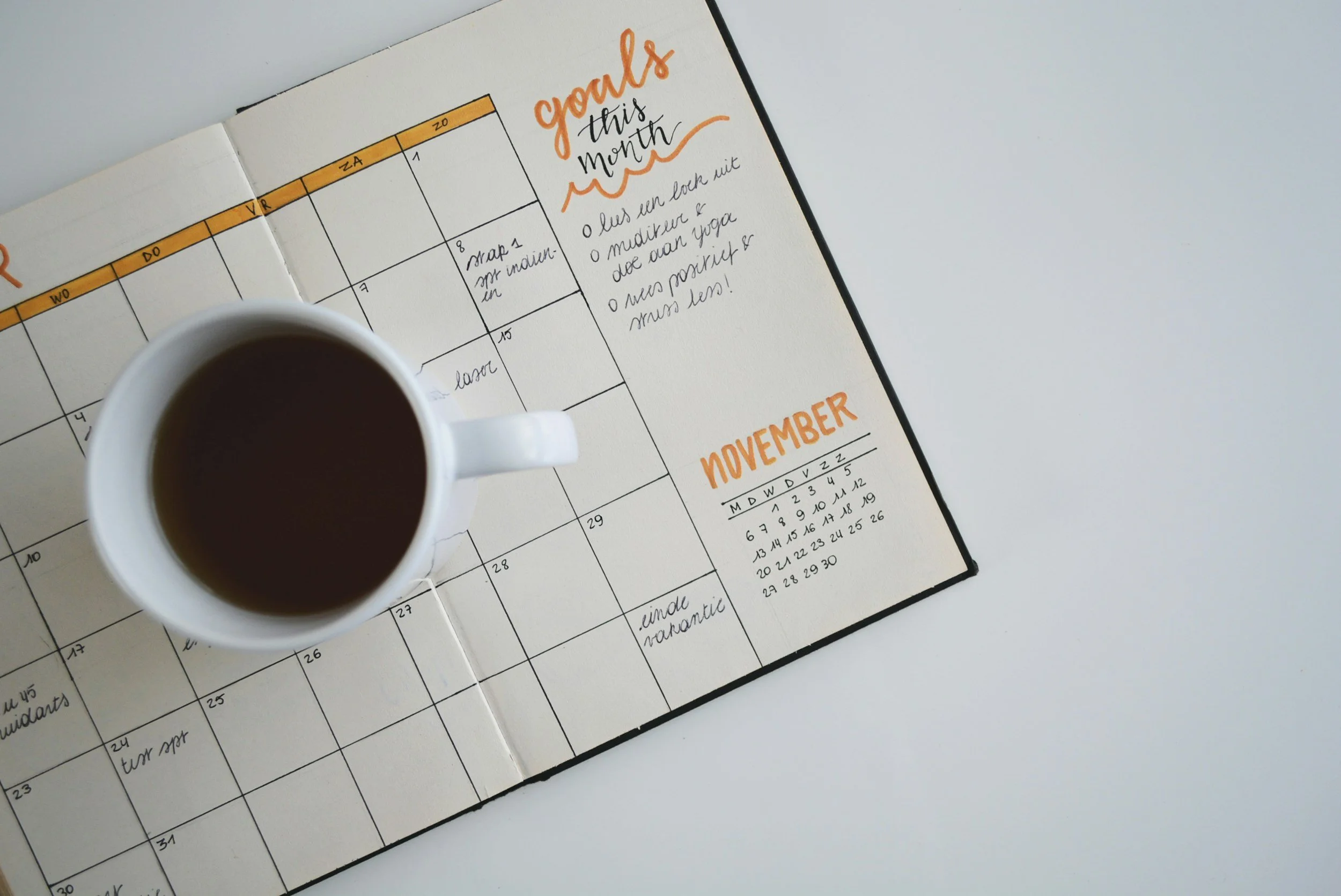
A couple of years ago, after opening my brand new day planner, I decided to try a radical new system — scheduling my weeks instead of listing them. Friends and coworkers had been suggesting I was “doing it wrong” for a while now. What did I have to lose? Appointments with dates and times were now listed on their date and time. Meals were assigned a specific date, as were household chores. This new way of planning my week allowed me to timeblock for work projects and manage my time differently. Don’t get me wrong, I did not miss many deadlines with the old to-do list system, but this allowed me to see when I could work on a project later in the week and how much time I would need to complete it before the weekend.
While I still make to-do lists for parties or one-off events, I am enjoying scheduling over listing. I still check completed tasks off from the calendar (and there is no mistaking how used this daily planner is now! Marks are everywhere.). This year, I even went so far as to buy erasable colored pens. There is no color-coded system, but my planner looks like a rainbow and as it turns out, that’s its own source of joy. Baby steps.
What about you, are you a lister, scheduler, or somewhere in between?
Hire an Editor
Even as a professional editor, there are times when I’ve finished up a particularly prickly proofreading job for a client and my first thought is “can someone look over this to see what I missed?!”
We make and leave mistakes in our writing for a variety of reasons, the most obvious one being because we are human. Other times we might not know better. And there’s always autocorrect fails! But that doesn’t mean we have to go quietly into that dark night of blatant mistakes. We can read our own work and we can hire a professional and do our level best to put our best foot forward. Always.
Misspellings and basic grammar errors will likely get flagged by your word processing program automatically. If you’re paying attention, you can correct those as they occur. But there are many common typos and mistakes made when writing that are honestly hard to catch. This is when an editor or proofreader can save the day.
Word mix-ups. English can be hard. We have plenty of words whose pronunciations or spellings are similar, but whose meanings or parts of speech are very different. Words like accept/except, mute/moot, further/farther, peek/peak/pique, lair/layer can trip up even seasoned writers. Along with your/you’re and there/their/they’re, these words are not always caught by your word processing program automatically. Your editor will know what word goes where.
Sentence fragments. This is another common issue not flagged in Google Docs or Word. Many authors can catch this issue when reading their work out loud but if you’re inclined to talk in unfinished sentences, it’s harder to catch on your own. Peer reviewers are good at catching incomplete sentences before something goes to print.
Run-on sentences. Sometimes a sentence can get too long and awkward for your reader. I love a long sentence. But the best way to communicate with others is to shorten those up and check for subject/verb agreement. An editor or peer reviewer is the best way to tighten up your writing. Word or Google Docs won’t do it for you.
Awkward wording. This can include ending a sentence in a preposition, misplacing subject or verb modifiers, unusual phrasing, verb tense shifts, excessive use of -ing words, etc. You should feel comfortable writing how you speak, but remember when writing, you have the benefit of a delete key and the time to edit what you say. I haven’t found a program yet that can catch an awkward or unclear sentence. But as an editor, I can stand in place of your reader and flag those sentences or phrases for you.
We will never reach 100% perfection on all writing projects. But we should still try our best to communicate clearly. While I believe “done is better than perfect” applies when folding a fitted sheet or loading the dishwasher, I think the phrase can lead to a careless attitude when regularly applied to your business.
Begin by reading your work out loud because this is truly one of the best ways to find mistakes in your writing and your message. But there is nothing quite like a peer or professional editor to take a second look at our work. Trust me, that professional editor is worth every penny. While editors cannot (or should not) promise you perfect or flawless work, we can help you take it to the next level.
Thank You

Just Send It

Track Changes are for Winners
Even as a professional editor, there are times when I’ve finished up a particularly prickly proofreading job for a client and my first thought is “can someone look over this to see what I missed?!”
We make and leave mistakes in our writing for a variety of reasons, the most obvious one being because we are human. Other times we might not know better. And there’s always autocorrect fails! But that doesn’t mean we have to go quietly into that dark night of blatant mistakes. We can read our own work and we can hire a professional and do our level best to put our best foot forward. Always.
Misspellings and basic grammar errors will likely get flagged by your word processing program automatically. If you’re paying attention, you can correct those as they occur. But there are many common typos and mistakes made when writing that are honestly hard to catch. This is when an editor or proofreader can save the day.
Word mix-ups. English can be hard. We have plenty of words whose pronunciations or spellings are similar, but whose meanings or parts of speech are very different. Words like accept/except, mute/moot, further/farther, peek/peak/pique, lair/layer can trip up even seasoned writers. Along with your/you’re and there/their/they’re, these words are not always caught by your word processing program automatically. Your editor will know what word goes where.
Sentence fragments. This is another common issue not flagged in Google Docs or Word. Many authors can catch this issue when reading their work out loud but if you’re inclined to talk in unfinished sentences, it’s harder to catch on your own. Peer reviewers are good at catching incomplete sentences before something goes to print.
Run-on sentences. Sometimes a sentence can get too long and awkward for your reader. I love a long sentence. But the best way to communicate with others is to shorten those up and check for subject/verb agreement. An editor or peer reviewer is the best way to tighten up your writing. Word or Google Docs won’t do it for you.
Awkward wording. This can include ending a sentence in a preposition, misplacing subject or verb modifiers, unusual phrasing, verb tense shifts, excessive use of -ing words, etc. You should feel comfortable writing how you speak, but remember when writing, you have the benefit of a delete key and the time to edit what you say. I haven’t found a program yet that can catch an awkward or unclear sentence. But as an editor, I can stand in place of your reader and flag those sentences or phrases for you.
We will never reach 100% perfection on all writing projects. But we should still try our best to communicate clearly. While I believe “done is better than perfect” applies when folding a fitted sheet or loading the dishwasher, I think the phrase can lead to a careless attitude when regularly applied to your business.
Begin by reading your work out loud because this is truly one of the best ways to find mistakes in your writing and your message. But there is nothing quite like a peer or professional editor to take a second look at our work. Trust me, that professional editor is worth every penny. While editors cannot (or should not) promise you perfect or flawless work, we can help you take it to the next level.

-Ing Verbs
I have seen this for years in both editing and correcting student papers. Authors spend a lot of time believing in, focusing on, helping with, sharing with, or working on. Or they were believing, have been focusing, helped with sharing, or were working on something. There’s nothing wrong with progressive or past perfect continuous verbs plus helping verbs — they exist in our language for a reason. But string too many together and your reader is left wondering if anything ever happened.
Action verbs are usually single words that describe what a person or thing (the subject) of a sentence does. Along with linking verbs, they can provide a more active and complete picture for your reader. Regardless of whether you write about something that is physically taxing, action verbs and linking verbs convey that you are in fact engaged, that you do or did something.
Here’s a quick example:
Past perfect continuous: He is reading.
Active: He reads.
While the first sentence does relay the message that the activity is ongoing, the second sentence is the one that sounds strong. And most of us want a strong message for our audience.
So why do we continue to use so many -ing verbs? You might be looking to soften your language (see what I did there?) so you sound more inclusive or less combative, depending on the circumstances. Or you might use an -ing verb to convey that the action continues. There’s no need to eliminate all -ing verbs from your writing but do be careful. They can make a sentence unnecessarily wordy, boring, or static. Remember that strong writers write strong sentences. They choose active verbs, reduce excessive wordiness, and take a powerful stance.
Here are some ways to minimize the use of -ing verbs in your writing:
Combine sentences or break them up. Instead of listing all the -ing verbs, pick an active verb and combine your thoughts using adverbs or phrases. Conversely, you can also change around a sentence with too many -ing verbs and break it into smaller sentences with more active verbs.
Use an active voice. Don’t be afraid of a strong statement, especially when you want to convey a clear and precise meaning to your audience. Tell ‘em like it is. You can be kind and direct at the same time.
Proofread. It’s okay if you write like you talk and you use a lot of -ing verbs when you’re conversing. Add in a step in your early proofreading to underline or note each of your -ing verbs. If you notice them stacking up, go back and change the sentence structure or pick a stronger active verb. Sometimes you simply need to cross out -ing and you’re good to go.
In law school, a friend agreed to peer review my first paper. Not sure how far he read before he handed it back with a copy of The Lawyer’s Guide to Writing Well by Tom Goldstein and Jethro K. Lieberman. “No offense meant here,” he told me. “But you have got to write about what actually happened.” Message received. It’s some of the best advice I’ve ever gotten on how to communicate by and through writing well.
Typos. Know Thyself

Best Ways to Use Find/Replace

Permission to Edit
Uncomfortable
I was recently challenged, through a professional organization, to get out of my comfort zone. Of course my initial reaction was “Me? It’s all my comfort zone! I am OUT THERE without a net all the time!” But upon further investigation, I found a lot of opportunities to step just a bit farther out of my comfort zone and try something new. Recently, I have expanded the kinds of editing services I do to include more fiction manuscripts at all levels of development. I’ve even stepped out of my comfort zone with marketing and talked more about my work via social media. These were definitely beyond my usual operating parameters.
Discomfort = Growth
While it would be comfortable to say “this is my niche for editing” (for me and my very overworked business coach), I’m not ready yet. I’m still exploring my options and remain incredibly curious about all aspects of freelance editing. So I’m going to stay in an uncomfortably broad area for a little bit longer. As it turns out, growth that feels uncomfortable also feels pretty good.
One Dreaded Conversation
But one aspect of my job remains uncomfortable for me and doesn’t feel like growing at all. I do not like having the conversation about rates and invoicing. Because I do not enjoy this part (odd because I do enjoy getting paid) I try to get it out of the way first thing. Smart to establish the contract for services at the very beginning — here is what you get and in return here is what I get — before any work is done. But sometimes, because a client is a referral from another client and either they need something quick or are bringing me in at the end of a project under deadline, I incorrectly assume they already know. And it becomes even more uncomfortable to send an email after a project is delivered and ask to whom I should address the invoice.
I have recently had two uncomfortable conversations about invoicing. They were both my fault because I delayed having them. The first one did not go as well as I had hoped and upon discovering how quickly editing services can add up, this client has decided to do more in-house. The second conversation, although just as uncomfortable for me, was remarkable. They accepted the project quote and had no issue at all with the idea that of course I would be paid for my labor. Because I am 100% committed to growing my freelance business, I will continue to have these uncomfortable conversations about invoicing and rates. Although I will be making them a priority to have AT THE BEGINNING of all projects.
Anyone Else?
This isn’t an issue for me alone. I’m sure there are quite a few of us out here who feel the same way, not just editors, but freelance entrepreneurs in all areas. We all have stories in our heads about money, about our worth, about what we do. Those stories provide us a framework for our work and these uncomfortable conversations. They may dictate whether or not we use the industry rate charts for our work or our reaction to a late invoice payment. I have anecdotal evidence to suggest this hits women harder than men and might explain why so many women (despite the advice from Betty Friedan) continue to donate/volunteer/give away our time and labor.
I’m glad I was challenged to get comfortable with being uncomfortable. It’s been a good way to grow and to also step out in courage, both excellent skills for any freelancer. It was also a good opportunity to take a hard look at what I love about being a freelance editor and which parts of the job I continue to avoid. What makes you uncomfortable? Are you ready to practice it anyway?
Scheduling time